
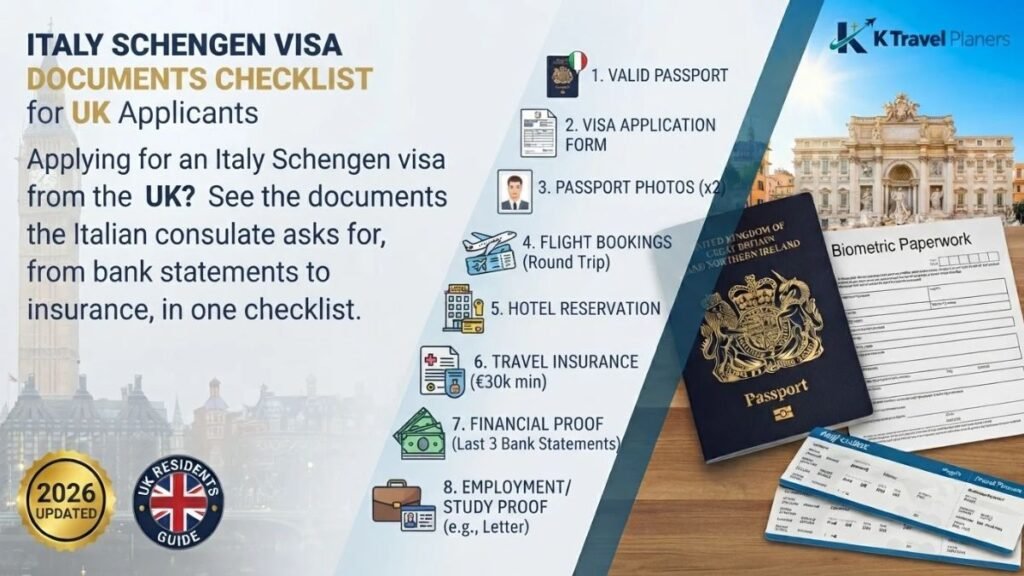
For a tourist Schengen visa to Italy from the UK, the Italian consulate asks for the completed form, your passport and UK residence documents, a photo, a cover letter, proof of your job or studies, a reserved return ticket, a hotel booking or host invitation, travel insurance of at least €30,000, and three months of personal UK bank statements. Everything must be printed, in original plus a photocopy where required, and you apply in person through VFS Global.
Italy is one of the most popular Schengen destinations for UK-based travellers, and its consulate in London publishes one of the more detailed checklists. That’s helpful, because it tells you exactly what to prepare. It also means small slips, such as an employer letter that’s six weeks old, can cost you your appointment.
This guide walks through the Italian checklist item by item, explains what each document is really for, and flags the details that catch people out.
K Travel Planners is an independent consultancy. We are not an embassy, consulate or official visa centre, and we can’t make or influence visa decisions. The Italian consulate decides every application and may ask for extra documents.
Before the checklist: who can apply, and where
You apply in person, always. The consulate states that applicants must appear in person at all times. Appointments are booked only through VFS Global, which also charges a service fee on top of the visa fee. Our appointment booking guide explains how the process works.
VFS Italy centres in the UK are in London, Manchester and Edinburgh (Leith). The London consulate says that to apply through it you must live in its consular district, which it lists as England, Wales, the Isle of Man, the Isle of Wight, the Channel Islands, Gibraltar, and South Georgia and the South Sandwich Islands. If you live elsewhere in the UK, such as Scotland or Northern Ireland, check which consular office covers you before you book. Applicants holding a UK “visit” (C-visit) visa aren’t eligible to apply.
The application must be complete on the day. The consulate says your application won’t be accepted unless you bring every required document, and if anything is missing you’ll need to book a new appointment. That’s a harsh rule, so treat the checklist below as a hard stop, not a guide.
The core Italy checklist (tourism)
Here’s the list from the consulate’s tourism page, turned into a table you can print. All documents must be printed, and the consulate asks for originals plus one photocopy where required.
| # | Document | What the consulate asks for | Watch out for |
|---|---|---|---|
| 1 | Application form | The consulate’s current form, fully completed and signed | Use the 2024 English/Italian form linked on the consulate site, not an old copy |
| 2 | Passport | Valid at least 3 months beyond your return from Italy, with at least 2 blank pages. Original plus one photocopy | The consulate keeps your passport and returns it with the visa |
| 3 | UK residence permit and eVisa share code | Original plus one photocopy, valid at least 1 month beyond your return (see the validity note below) | Print your share code details. Don’t rely on showing them on a phone |
| 4 | Photo | Passport-style, full face, white background, not older than 6 months | A recent photo, not one reused from last year |
| 5 | Cover letter | Explaining your trip | Must match your itinerary. See our cover letter tips |
| 6 | Proof of work, study or status | Depends on your situation (see next table) | Date limits are strict |
| 7 | Return ticket reservation | Reserved return to the UK, printed directly from the airline, train or bus operator showing your name, dates, from/to and price | A reservation counts, but it must be a real one from the operator |
| 8 | Accommodation or invitation | A fully booked hotel reservation, or an original invitation letter from your host in Italy | Host’s ID or passport copy required; if the host isn’t an EU citizen, their Italian residence permit too |
| 9 | Travel insurance | Issued in the UK or a Schengen country, covering your whole stay, with a letter from the insurer confirming cover across all Schengen countries and at least €30,000 for medical costs, hospitalisation and repatriation | The letter matters, not just the policy document |
| 10 | Proof of funds | Last three months of personal UK bank statements showing your name, address and history | At least one account must show your salary, pension or universal credit coming in |
If you’re travelling to several Schengen countries, the consulate says travel reservations showing your name, dates and from/to between each country are mandatory. If you’re travelling by car, it asks for ferry or Eurotunnel reservations. Our itinerary guide shows how to line all of this up.
A validity detail to double-check
The consulate’s general visa page says passports, travel documents and residence cards or share codes must be valid at least three months beyond the last day of your trip. Its tourism checklist says the UK residence permit and share code need to be valid at least one month beyond your return. The two pages don’t agree, so the safe approach is to make sure your UK permission extends at least three months past your return. If it doesn’t, ask VFS or the consulate before you book.
Proof of your work or study situation
This is the section where applications most often stumble, because the consulate is specific about format and freshness.
| Your situation | What to provide |
|---|---|
| Employed | A recent employer letter (not older than one month) with company registration number, employment start date, job title, annual salary and vacation period, plus your last three payslips (original and photocopies) |
| Student | A recent, official, signed letter from your school, college or university stating date of issue, your name, type of studies, hours per week and attendance record |
| Self-employed | A recent, official, signed letter from an accountant, banker or solicitor with their name, date, address, contact details, position and UK registration number, stating the nature of your business. It must also state the annual salary drawn from the company, plus your HMRC self-assessment |
| Retired | Proof of your retirement income from social security |
| Unemployed, dependent on a spouse, partner or parent | The sponsor’s employment letter and payslips, plus joint tax return, or your marriage, civil partnership or birth certificate with a sponsorship letter and a copy of the sponsor’s passport |
| Dependent child | Parents’ last three months’ bank statements and payslips, the child’s original birth certificate, a sponsorship letter and a copy of the sponsoring parent’s passport |
A few Italy-specific rules for certificates:
- Marriage or civil partnership certificates older than six months are not accepted.
- Certificates issued outside the UK must be translated into English or Italian and legalised by the Italian consular office in the issuing country, or by that country’s consular authority in the UK.
- Certificates from other Schengen countries are accepted only in multilingual format, otherwise the translation and legalisation rule applies.
For children, if one or both parents don’t attend the appointment, the consulate requires parental consent notarised by a UK notary, plus photocopies of both parents’ passports.
Extra requirement for some nationalities
Citizens of Pakistan, Afghanistan, Iraq, Palestine and Yemen, and holders of certain travel documents, need to provide their mother’s and father’s full names, and these must be evidenced by a birth certificate or a consular declaration. If you hold a Pakistani passport, don’t leave this to the day, because getting a birth certificate or consular declaration can take time. Our guide on how nationality affects a Schengen application from the UK explains the wider picture.
Fees, timing and getting your passport back
Visa fee. Paid in British pounds only. At the consulate’s own visa office it’s cash only, while at VFS centres you can pay by cash or card. VFS charges a separate service fee.
Processing. The consulate says it can take up to 45 days for a Schengen visa depending on the type and your citizenship, with a minimum of 15 days. It also says processing can’t be rushed. Plan with that in mind, and see our guide on how far in advance to apply.
Your passport. At VFS centres it can be collected or posted. If you use the consulate’s own office, passports are returned by post, and you’ll need a pre-paid envelope and a signed posting declaration.
Timing limits. You can apply up to six months before travel and, as a rule, no later than 15 calendar days before.
A transit point worth knowing
Italy’s consulate says that since 28 June 2024, UK residents holding a valid UK Biometric Residence Permit no longer need an airport transit visa to transit through an Italian airport. It stresses this applies to BRP card holders only, and a UK visa on its own doesn’t give the exemption. With BRPs being replaced by eVisas, confirm how this applies to you before you rely on it.
An example to make it concrete
Here’s an illustrative scenario, not a real client case.
Hira works full time in Bradford and holds a Pakistani passport and ILR. She’s planning a week in Rome. She has her bank statements, insurance and hotel booking ready weeks ahead.
At the last minute she remembers the employer letter. HR gave her one a month and a half ago for something else. It has her job title and salary but no company registration number, and it’s more than a month old. She asks for a fresh one with every item the consulate lists. She also realises the consulate wants her parents’ full names evidenced by a birth certificate, and she’s glad she checked early.
Neither of those things is dramatic. But either one, on the day, could have meant rebooking an appointment.
Italy-specific mistakes to avoid
An employer letter that’s too old or missing details. It must be under a month old and include the registration number, start date, job title, annual salary and vacation period.
Insurance without the confirmation letter. A policy certificate isn’t enough on its own.
Bank statements that don’t show income. At least one account must show salary, pension or universal credit arriving.
No printed share code. Bring the printed details, not just a screen.
A reservation that doesn’t come from the operator. Print it from the airline or train company showing the details the consulate lists.
Forgetting the parents’ names rule. For Pakistani passport holders especially.
Expired or soon-to-expire UK permission. Check the validity gap before you book.
Using an old form. Download the current one from the consulate.
Assuming a missing document can be dropped in later. The consulate says the application won’t be accepted if documents are missing.
Your final checklist
- [ ] Current application form, signed
- [ ] Passport with 3+ months validity after return and 2 blank pages, plus photocopy
- [ ] UK residence permit and printed eVisa share code details, plus photocopies
- [ ] Recent passport-style photo (under 6 months old)
- [ ] Cover letter matching your itinerary
- [ ] Employer, university or accountant letter in the exact format, plus payslips if employed
- [ ] Printed return ticket reservation (and tickets between countries if multi-country)
- [ ] Hotel booking, or original host invitation with host ID
- [ ] Insurance policy and insurer’s confirmation letter (€30,000, all Schengen countries)
- [ ] Three months of personal UK bank statements showing income
- [ ] Parents’ names evidence, certificates and sponsorship letters if they apply
- [ ] Visa fee and VFS service fee payment method (British pounds)
For the wider set of documents, our general Schengen visa documents checklist and Italy country page go further, and our complete guide to applying from the UK covers the whole process.
How K Travel Planners can help
We can’t guarantee a visa, an appointment or a processing time, and nobody honest can. What we can do is check your documents against the Italian consulate’s checklist, spot mismatches before you get to the VFS counter, and help you write a clear cover letter. See our Schengen document checking service, or get in touch with your passport nationality, UK status, UK region and travel dates. Please don’t send passport scans or financial documents until a secure method has been agreed.
Frequently asked questions
What documents do I need for an Italy Schengen visa from the UK?
The Italian consulate asks for the completed form, passport, UK residence permit and eVisa share code, a photo, a cover letter, proof of work or study, a reserved return ticket, a hotel booking or host invitation, travel insurance of at least €30,000, and three months of personal UK bank statements.
Does Italy require a return ticket?
Yes, it asks for proof of a reserved return ticket to the UK, printed directly from the airline, train or bus operator, showing your name, dates, route and price. For multi-country trips, reservations between each country are required.
How many months of bank statements do I need?
Three months of personal UK bank statements showing your name, address and financial history. At least one account must show your salary, pension or universal credit being paid in.
Can I apply for an Italy visa if I live in Scotland or Northern Ireland?
The London consulate lists England, Wales, the Isle of Man, the Isle of Wight, the Channel Islands, Gibraltar and South Georgia and the South Sandwich Islands as its consular district, and says applicants outside that area aren’t eligible through it. Check which Italian consular office covers your region before booking.
How long does an Italy Schengen visa take from the UK?
The consulate says the minimum is 15 days and it can take up to 45 days depending on the visa type and your citizenship. It says processing can’t be rushed.
Can I bring documents on my phone?
No. The consulate states all documents must be printed and presented in original plus a photocopy where required.