
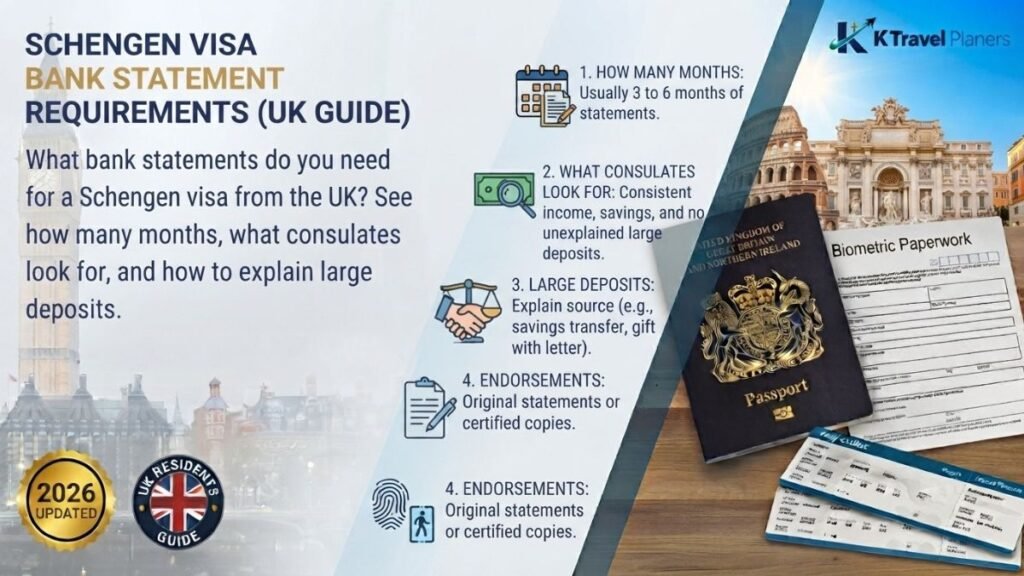
Most Schengen consulates ask for your personal UK bank statements for the last three months, in your name, showing regular income and a balance that comfortably covers your trip. The exact format, account types and amounts differ by country, so follow your embassy’s checklist. What consulates are really checking is whether your money is genuine, consistent with your job and enough for the trip you’ve described.
Bank statements are the document people worry about most, and for good reason. They’re personal, they reveal your finances, and a single odd-looking transaction can feel like it needs a lawyer.
In practice, officers aren’t looking for wealth. They’re looking for a believable story. A modest balance that matches a modest trip and a steady salary is far more convincing than a large balance that appeared last week.
This guide explains what most consulates ask for, how to present your statements properly, how to handle awkward details like a large deposit, and the mistakes that cause problems.
K Travel Planners is an independent consultancy. We are not an embassy, consulate or visa application centre, and we can’t make or influence visa decisions. Always follow your destination embassy’s own checklist.
Why consulates ask for bank statements
The EU Visa Code requires applicants to show they have enough money to cover the trip and the return journey, or that they can obtain it lawfully. Bank statements are the standard way to show it.
They also help the consulate check three other things at once:
Your identity and address. The name and address should match your passport and residence evidence.
Your income. Regular salary, pension or benefit payments back up your employer letter and payslips.
Your circumstances. A steady account with normal activity suggests a settled life in the UK, which supports the idea that you’ll return.
What embassies typically ask for
There’s no single EU-wide rule on how many months or how much money. Each country sets its own checklist. Here are the two we’ve verified in detail, plus the general pattern.
| Country | What the official or provider checklist says |
|---|---|
| Italy | The Italian consulate in London asks for the last three months of personal UK bank statements showing your name, address and history. At least one account must show your salary, pension or universal credit being paid in |
| Germany | TLScontact’s UK checklists ask for UK bank statements in your name showing movements over at least the last three months. For its family and friends visit checklist it asks for a current balance of at least £40 per day for the whole stay. Its business checklist says the balance should also cover accommodation if it isn’t prepaid |
| Most others | Typically the last three months, personal account, name and address visible, income visible. Some ask for six months or specific account types |
Two caveats. The German £40 per day figure comes from one TLScontact checklist, so check the checklist for your own category. And other countries differ, so see our documents checklist and each country page for specifics.
For a detailed example of how a consulate sets this out, see our Italy documents checklist.
What consulates look for in your statements
Think of the officer reading your statements with a few questions in mind.
1. Is it yours? The name, address and account number should match your other documents. Joint accounts need extra care (more below).
2. Is there regular income? Salary, pension, benefits or business income arriving at the expected times. Italy explicitly asks for this.
3. Is the balance proportionate? Does it comfortably cover the trip you’ve described, with room to spare? You don’t need a fortune, but it should make sense against your itinerary and costs.
4. Is the activity normal? Everyday spending, bills and transfers look natural. An account with no activity, or one opened very recently, raises questions.
5. Are there unexplained jumps? A large deposit shortly before your application is the classic red flag. It isn’t fatal, but it needs an honest explanation.
6. Does it match the rest of your file? Salary in the statement should be consistent with your payslips and employer letter.
How to present your statements properly
Small formatting slips cause more trouble than people expect.
Use the period your embassy asks for. Three months is the common baseline. Use the most recent complete months, and make sure the statement runs up to a date close to your application.
Print the full statement. Every page, with the account holder’s name, address, account number and sort code visible. Don’t crop or screenshot.
Download from your bank. Online banking PDFs are widely used, but some consulates prefer or require a bank stamp or signature. Check your embassy’s checklist. If it asks for a stamp, ask your branch.
Digital banks. If your account is with a digital-only bank, check the statement shows your name, address and account details clearly. If something is missing, ask the bank for a formal statement.
Keep currency consistent. UK pounds are fine. If you have funds in another currency, a consulate may want them converted or authenticated by the bank.
Bring originals if asked. The Italian consulate requires printed documents, with originals plus a photocopy where required. Don’t rely on showing statements on your phone.
Don’t edit anything. Never alter, blank out or “tidy” a statement. Altered documents can lead to a refusal and a longer-term problem.
How much money is enough?
There’s no universal figure. Consulates look at your balance against the cost of the trip, and some publish reference amounts per day. Germany’s TLScontact family and friends checklist, for example, mentions £40 per day. Others use euro daily amounts.
A practical way to think about it:
- Add up flights, accommodation, insurance, local transport, food and activities.
- Compare that with your balance and the income your statements show.
- Leave a comfortable margin. A balance that exactly matches the trip leaves no room for error.
- Make sure the lifestyle your trip implies is consistent with your income.
Our itinerary guide helps you work out realistic costs.
Large deposits: how to handle them honestly
This is the part that worries people most. Life happens: a bonus, a gift from a relative, a sale, a tax refund. These aren’t suspicious in themselves, but a consulate will want to understand them.
Don’t hide or avoid them. An unexplained deposit looks worse than an explained one.
Don’t make temporary deposits. Putting money in just before applying and taking it out after, sometimes called “window dressing”, can be spotted by comparing statements and income, and it can lead to a refusal for unreliable information.
Do explain and evidence it. A short note with supporting proof is usually enough. For example:
Explanation of deposit

On [date], a deposit of £[amount] was credited to my account
ending [last 4 digits]. This was [a gift from my sister,
[name], to help with family travel costs / the proceeds of the
sale of my car / my annual bonus from [employer]].

Supporting evidence enclosed: [gift letter and the sender's
bank transfer record / sale receipt / bonus payslip].

Signed: [name]    Date: [date]
Attach the supporting document: a payslip, a sale receipt, or a signed letter from the person who gave the money, with proof of the transfer.
Different situations
Employed. Your statements should show salary arriving at regular intervals, matching your payslips and employer letter. Italy asks specifically for at least one account showing income.
Self-employed or a company director. Use personal statements alongside business evidence your embassy asks for, such as an accountant’s letter and tax records. Personal statements should show drawings or salary consistent with your documents. Don’t overstate income.
Students. If you rely on savings, a student loan or family support, show it clearly. If a family member funds you, you may need their statements and a sponsorship letter.
Retired. Pension payments in the account are the key evidence.
Dependants and sponsored travellers. If someone else is paying, you’ll usually need their bank statements, a signed sponsor letter, proof of your relationship and a copy of their passport. Check the embassy’s rules, since requirements vary.
Joint accounts. Many consulates accept them if your name is on the account, but check. If the other holder is paying for the trip, expect to show their consent or relationship.
Savings accounts, ISAs, cash and crypto. Some consulates won’t accept certain account types, fixed deposits, or cash as evidence of funds. Check your embassy’s rules before relying on them. If you hold money elsewhere, move or document it in a way the checklist allows.
Credit cards. A credit limit usually isn’t treated as your own money, and some checklists say statements for these aren’t accepted. Don’t rely on one.
An example to make it concrete
Here’s an illustrative scenario, not a real client case.
Imran works in Leicester as a Skilled Worker and earns a steady salary, paid on the 28th of each month. He’s planning a week in Rome with his cousin. His three months of statements show salary arriving on time and a healthy but ordinary balance.
Two weeks before his appointment, his uncle sends him £3,000 as a gift towards family travel. Imran’s first instinct is to leave it unexplained and hope nobody notices.
He decides to do it properly. He asks his uncle for a short signed letter, keeps the transfer record, and adds a one-paragraph note with the date and amount. The statements, payslips and employer letter now all tell the same story, with the deposit explained.
It isn’t a guarantee, and nobody can promise one. But it’s the kind of openness that tends to leave an officer with fewer questions, not more.
Common bank statement mistakes
Statements that are too old. Use the most recent months, ending near your application date.
Missing pages. Partial statements look incomplete.
Name or address mismatch. If your address on the account is out of date, update it before you print.
No visible income. If your salary goes to another account, include that one, as Italy requires an account showing income.
Unexplained large deposits. Explain them truthfully, with proof.
Last-minute top-ups. They’re easier to spot than people think.
A balance that doesn’t fit the trip. A luxury itinerary on a small balance raises doubts.
Using a credit card as proof of funds. Many checklists don’t accept it.
Altering or cropping statements. Never do this.
Forgetting the stamp rule. Some embassies want a bank stamp.
Quick checklist
- [ ] Statements for the period your embassy asks for, normally the last three months
- [ ] Full statement, every page, with name, address, account number and sort code
- [ ] Ending close to your application date
- [ ] Salary, pension or benefit income visible
- [ ] Balance comfortably covers your trip
- [ ] Large deposits explained and evidenced
- [ ] Matches your payslips and employer letter
- [ ] Bank stamp or original printouts if your embassy requires them
- [ ] Sponsor documents ready if someone else is paying
For the bigger picture, our complete guide to applying for a Schengen visa from the UK walks through every stage, and our guides on how far in advance to apply and UK visa centres help with timing and booking. If you’re applying to Italy, our Italy appointment guide covers the booking steps, and our Germany and Italy pages have country details.
How K Travel Planners can help
We can’t guarantee a visa, an appointment or a processing time, and nobody honest can. What we can do is review your statements against your embassy’s checklist, spot mismatches with your other documents, and help you explain unusual transactions clearly and truthfully. See our Schengen document checking service or Schengen visa consultation, or get in touch with your destination, UK status and travel dates. Please don’t send passport scans or financial documents until a secure method has been agreed.
Frequently asked questions
What bank statements do I need for a Schengen visa from the UK?
Most consulates ask for personal UK bank statements for the last three months, in your name, showing regular income and a balance that covers your trip. The Italian consulate, for example, asks for three months showing name, address and history, with at least one account showing salary, pension or universal credit. Always check your own embassy’s checklist.
How many months of bank statements do I need?
Three months is the common baseline, though some embassies ask for more. Use the most recent complete months, ending close to your application date.
Can I use online bank statements?
Often yes, if they’re complete printouts showing your name, address and account details. Some consulates prefer or require a bank stamp or original statements, so check your embassy’s checklist before you rely on a downloaded PDF.
How do I explain a large deposit?
Be honest and provide evidence. Write a short note with the date, amount and source, and attach proof such as a payslip, sale receipt or a signed letter from the person who gave you the money, with the transfer record.
How much money should be in my account?
There’s no EU-wide minimum. Consulates compare your balance with the cost of your trip, and some publish per-day reference amounts. Germany’s TLScontact family and friends checklist, for instance, mentions at least £40 per day. Leave a comfortable margin above your estimated costs.
Can I use a joint account or a sponsor’s statements?
Many consulates accept joint accounts where your name appears. If someone else is paying, you’ll usually need their statements, a signed sponsor letter, proof of your relationship and a passport copy. Check what your embassy requires.
Are savings accounts or credit cards accepted?
It depends on the embassy. Some don’t accept certain savings or fixed deposit accounts, cash, or credit card limits as proof of funds. Check the checklist before relying on them.