
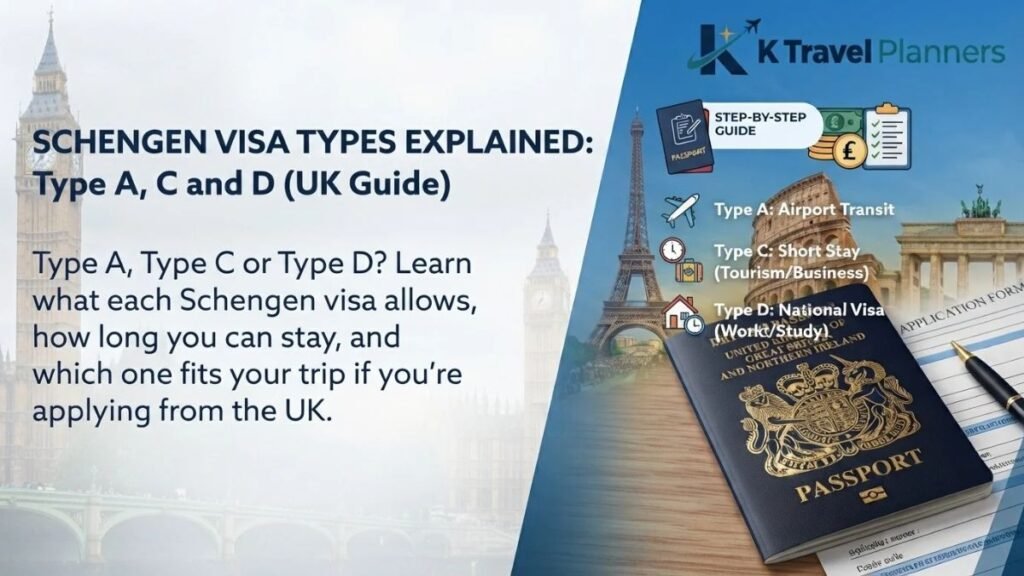
There are three main visas you’ll hear about. Type C is the standard short-stay visa, valid for up to 90 days in any 180-day period, and it’s what most tourists, business visitors and family visitors need. Type A is an airport transit visa for passing through a Schengen airport without entering the country. Type D is a national long-stay visa for stays longer than 90 days, such as study or work, issued by one specific country.
If you’ve searched for “Schengen visa” and found a confusing mix of letters, you’re not alone. Every official page and every forum seems to use a different shorthand, and it’s hard to tell whether they’re all talking about the same thing.
They aren’t. Choosing the wrong type is one of the more avoidable ways to waste an appointment and a fee, so it’s worth five minutes to get this right before you start any paperwork.
This guide explains each type in plain language, shows how they differ, and helps you work out which one you actually need.
K Travel Planners is an independent consultancy. We are not an embassy, consulate or official visa centre, and we can’t make or influence visa decisions.
The types at a glance
| Type | What it’s for | How long | Where it works |
|---|---|---|---|
| Type A | Airport transit only | Time needed to change planes | International transit area of a Schengen airport |
| Type C | Short stays: tourism, family, business, events | Up to 90 days in any 180 days | Usually all Schengen countries |
| Type D | Long stays: study, work, family reunion | More than 90 days | The issuing country, plus short travel to other Schengen states |
Think of it this way. Type A is for passing through. Type C is for visiting. Type D is for living there.
Type C: the short-stay visa most people need
If you’re planning a holiday, a trip to see relatives, a conference or a short course, this is almost certainly your visa.
A Type C visa lets you stay in the Schengen Area for up to 90 days in any rolling 180-day period. The 90 days are counted across all Schengen countries together, not per country. So ten days in Italy, then fifteen in France, uses twenty-five days of the same allowance.
What you can do on it
Typical purposes include:
- Tourism and sightseeing
- Visiting family or friends
- Business meetings, trade fairs and conferences
- Cultural or sports events
- Short courses and short-term training
- Medical visits
What you can’t do
A Type C visa isn’t a work permit. You can attend meetings or negotiate a contract, but you generally can’t take up employment, work for a local company or run a business there. It also doesn’t lead to residence. If you plan to move or stay longer than 90 days, you’re looking at the wrong visa.
Single, double or multiple entry
Your visa will state how many times you can enter.
- Single entry: you can enter once. Once you leave, the visa is used up, even if there are days left on it.
- Double entry: you can enter twice.
- Multiple entry: you can enter and leave several times while the visa is valid, always within the 90/180 limit.
Consulates decide this based on your itinerary, travel history and the purpose of your trip. Asking for multiple entry doesn’t mean you’ll receive it, and frequent travellers with a good record of complying with previous visas are more likely to be considered for longer multiple-entry visas. The details depend on your nationality and the consulate’s assessment.
Validity is not the same as duration
Here’s the thing that catches people out. A visa may be valid from 1 June to 30 June but allow only ten days of stay. The validity window is when you can enter and travel. The duration of stay is how many days you can actually spend there. Look at both boxes on your visa sticker before you book anything.
Uniform versus limited validity
Most Type C visas are “uniform”, meaning they’re valid across the whole Schengen Area. Occasionally a consulate issues a visa with limited territorial validity, which works only in the country or countries named on it. If yours is limited, check carefully before booking trips to other countries.
Type A: the airport transit visa
This one is the most overlooked.
A Type A visa allows you to pass through the international transit area of a Schengen airport without entering Schengen territory. You land, you stay airside, you board your next flight. You don’t clear immigration, collect bags or leave the building.
Some nationalities need this visa even for a connection that never leaves the terminal. The EU has a common list of nationalities that require an airport transit visa, which includes, for example, Pakistani, Bangladeshi, Nigerian and Ghanaian passport holders, and individual countries can add to that list. Check the current rules for your passport and your connecting airport. Don’t assume.
A quick example. Priya lives in Leicester, holds an Indian passport and wants to fly to Toronto via Frankfurt. She’s not planning to leave the airport, so she assumes she needs nothing. Whether that’s true depends on her passport and Germany’s transit rules. If she’s wrong, an airline can refuse to let her board in the UK, long before she reaches Germany.
The cleanest fix is to choose a route through a non-Schengen hub if possible, or confirm the transit rule with the embassy of the airport’s country before booking.
A note on Type B. Older websites mention a “Type B” transit visa for road or rail travel through Schengen states. It’s no longer issued, so if a source tells you to apply for one, treat that source as out of date.
Type D: the national long-stay visa
A Type D visa is a different animal from the other two. It isn’t a short-stay Schengen visa at all. It’s a national visa, issued by a single country under its own immigration rules, for stays longer than 90 days.
Typical reasons include:
- Full-time or degree-level study
- Employment
- Family reunion
- Research or training programmes
- Other national routes, such as self-employment or a long-term residence plan
Each country sets its own requirements, forms, fees and processing times. Germany’s national visa process, for example, isn’t the same as France’s, and neither matches Spain’s. The process usually leads to a residence permit once you arrive, and a Type D holder can generally travel to other Schengen countries for short stays while the visa is valid, subject to the 90/180 rule.
If you’re even partly planning to relocate, don’t apply for a Type C and “see what happens”. A short-stay visa can’t be converted into a long-stay one, and trying to stay beyond what your visa allows creates real trouble.
An illustrative example. Daniel, a software developer in Manchester, gets a job offer from a company in Berlin. He thinks, “I’ll just apply for a Schengen visa and sort the rest out when I arrive.” That plan doesn’t work. He needs the German national visa route for employment, which has its own checklist and its own timeline. Applying for a Type C would be the wrong application from the start.
You can read more about how individual countries approach UK applications on our Germany and France pages.
How to decide which one you need
Work through these in order.
- Are you only changing planes? If you won’t leave the airport’s international zone, check whether your passport and the airport’s country require a Type A transit visa.
- Will you stay 90 days or less, in any 180-day period? If so, and the purpose is a visit, business meeting, event or short course, it’s a Type C.
- Will you stay longer than 90 days, or are you moving to study or work? That points to a Type D national visa, applied for through the specific country’s own route.
- Not sure? Look at what you’ll actually do on the ground. Visiting and attending meetings point to C. Living, working or studying for months point to D.
For multi-country trips, the next question is which country to apply to. That’s covered in our guide on which Schengen country you should apply to.
Common mistakes with visa types
Applying for a short-stay visa when the plan is to move. This is the most serious one. It creates a mismatch between your stated purpose and your real intention.
Ignoring transit rules. People plan a “simple connection” and discover the airline won’t board them without a transit visa.
Assuming the visa type sets the fee. Fees depend on the visa category and country rules. The standard adult fee for a Type C or Type A visa is currently €90, but national Type D fees differ by country. Check the official source before budgeting.
Reading old information. The “Type B” visa and several older rules still circulate online. Always check a recent official page.
Treating the visa as a guarantee of entry. A visa lets you present yourself at the border. The border officer can still ask questions and refuse entry if conditions aren’t met.
Mixing up “do I need one” with “which one do I need”. If you’re not sure whether you need a visa at all, start with our guide on whether you need a Schengen visa if you live in the UK.
What to do next
Once you know you need a Type C visa, the next step is to line up your documents and your itinerary. Our complete guide to applying for a Schengen visa from the UK walks through the whole process, our documents checklist shows what to prepare, and our cover letter tips help you explain your purpose clearly.
If your plans involve a long stay, we’d suggest checking the destination country’s official national visa page before anything else.
How K Travel Planners can help
We can’t guarantee a visa, an appointment or a processing time, and nobody honest can. What we can do is help you work out which route fits your plans, check that your documents tell one consistent story, and prepare you for what the official process asks. Take a look at our Schengen visa consultation or Schengen visa application assistance, or get in touch with your passport nationality, UK status, destination and rough dates. Please don’t send passport scans or financial documents until a secure method has been agreed.
Frequently asked questions
What is the difference between Type C and Type D?
Type C is a short-stay visa for up to 90 days in any 180-day period, valid across the Schengen Area. Type D is a national long-stay visa issued by one country for stays over 90 days, such as study or work. They have separate rules, forms and processes.
Do I need an airport transit visa?
It depends on your passport and the airport you’re connecting through. Some nationalities need a Type A visa even if they never leave the international transit area. Check the transit rules of the country where you’ll change planes, before you book.
Can I work on a Schengen Type C visa?
No. A Type C visa allows visits such as tourism, family visits and business meetings, but not employment or running a business locally. For work, look at the destination country’s national visa options.
Can I turn a Type C visa into a long-stay permit?
Generally not. A short-stay visa isn’t designed to be converted into residence. If you plan to live, study or work abroad, apply for the right national visa from the start.
What’s the difference between single and multiple entry?
A single-entry visa lets you enter once. A multiple-entry visa lets you enter and leave several times during its validity, within the 90/180 limit. The consulate decides what to grant, based on your itinerary and travel history.