
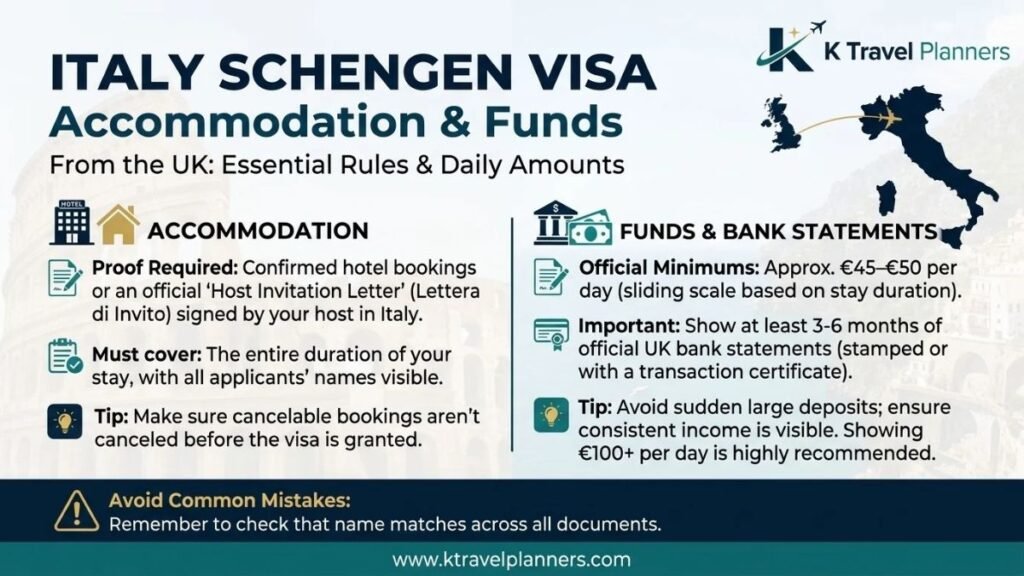
For an Italy Schengen visa, you need to show where you’ll stay for every night of the trip and that you have enough money to pay for it. The Italian consulate in London asks for a fully booked hotel reservation or an original invitation letter from your host, plus three months of personal UK bank statements. Italy also publishes minimum daily amounts, from €269.60 in total for a trip of up to five days to €44.93 per day for six to ten days, but consulates expect your funds to match the real cost of your trip.
Accommodation and money are the two things an Italian consulate checks hardest. They answer a simple question: can you actually do the trip you’ve described, without relying on anyone or anything you haven’t shown them?
The good news is that Italy is unusually clear about this. It publishes an official table, and the consulate in London spells out what it wants for hotels and hosts. The trouble is that most online advice is vague, copied or out of date.
This guide explains the Italian rules, how to work out your own numbers, and how to present everything so the story is consistent.
K Travel Planners is an independent consultancy. We are not an embassy, consulate or visa application centre, and we can’t make or influence visa decisions. Always follow the Italian consulate’s current checklist.
Part 1: Proof of accommodation
What the consulate asks for
The Italian Consulate General in London’s tourist checklist asks for one of two things:
- A fully booked hotel reservation, or
- An original invitation letter from your host in Italy, with a copy of the host’s ID or passport. If the host isn’t an EU citizen, their Italian residence permit is needed too.
Our Italy documents checklist lists the whole set. If you’re travelling to several Schengen countries, the consulate also asks for reservations showing your name, dates and route between each country.
Option A: hotels and rentals
A good hotel booking shows:
- Your name as the guest
- The hotel’s name, address and contact details
- Check-in and check-out dates
- A confirmation or booking reference
Cover every night. If you’re moving between cities, you need a booking for each stay, and the dates should join up. A gap of one or two nights with no explanation is the kind of thing that raises questions. If you’ll be on an overnight train, say so in your itinerary.
Use flexible bookings. Many people choose reservations they can cancel for free until shortly before arrival, because you don’t want to pay for non-refundable bookings before you know the result. Make sure the booking is genuine and shows the details above. Fake or unverifiable bookings can cause real trouble.
Match everything. The hotel dates should agree with your flight reservation, itinerary, cover letter and application form. Our itinerary guide shows how to line it all up.
Option B: staying with a host
If you’ll stay with family or friends in Italy:
- Original invitation letter from your host, signed and dated
- Copy of your host’s ID or passport
- Host’s Italian residence permit, if they aren’t an EU citizen
A strong invitation letter typically includes:
- The host’s full name, date of birth, address and phone number
- Your full name, date of birth and passport number
- The relationship between you
- Your arrival and departure dates
- Where you’ll stay and for how long
- Who is paying for what
- The host’s signature
If you can add evidence of the relationship, such as a family document or photographs, that can help. Check the London consulate’s page for the exact format it wants, because some Italian missions elsewhere use a specific host declaration form, and requirements differ by location.
Option C: a mix
Plenty of trips combine both: three nights with a cousin in Milan, then two in a Florence hotel. Provide the right evidence for each part, and make sure the dates join up with no gaps.
Part 2: Proof of funds
Italy’s official minimums
Italy sets minimum amounts of means of subsistence through an Interior Ministry directive of 1 March 2000. The amounts shown in the Italian system and in the European Commission’s Visa Code Handbook are:
| Length of stay | Per person travelling alone | Each additional person travelling together |
|---|---|---|
| 1 to 5 days | €269.60 in total | €212.81 in total |
| 6 to 10 days | €44.93 per day | €26.33 per day |
| 11 to 20 days | €51.64 plus €36.67 per day | €25.82 plus €22.21 per day |
| More than 20 days | €206.58 plus €27.89 per day | €118.79 plus €17.04 per day |
Here’s what that means for a single traveller:
| Trip length | Minimum under the Italian table |
|---|---|
| 5 days | €269.60 |
| 7 days | €314.51 |
| 10 days | €449.30 |
| 14 days | €565.02 |
| 21 days | €792.27 |
Why you shouldn’t aim for the minimum
The table is a floor, not a target, and it dates from 2000. A consulate also looks at what your trip will actually cost.
Imagine a seven-night trip with a £110-per-night hotel. The accommodation alone is £770, well beyond the €314 table minimum. If your balance only just clears the table, but your itinerary costs far more, the numbers won’t add up.
A sensible way to work it out:
- Add up your real costs: flights, accommodation, insurance, local transport, food and activities.
- Check it against the table to make sure you’re above the official minimum.
- Use the higher of the two, then add a comfortable margin.
- Check your income supports it. Your statements should show a lifestyle consistent with the trip.
The directive also allows prepaid services, such as a paid hotel or transport, to count as evidence of means. If you’ve prepaid part of the trip, mention it and include the proof, and check with the consulate how it should be presented.
How to show your funds
The consulate in London asks for three months of personal UK bank statements showing your name, address and history, with at least one account showing salary, pension or universal credit arriving. Our guide on bank statement requirements goes through formatting, large deposits and different situations in detail.
If someone else is paying, you’ll usually need their documents too: their bank statements, a signed sponsor letter, proof of your relationship and a copy of their passport. If you’re an employed applicant, your employer letter should be under a month old and include the details the consulate lists.
An example to make it concrete
Here’s an illustrative scenario, not a real client case.
Priya, an Indian national with a Skilled Worker visa in Reading, plans an eight-day trip to Italy: three nights in Rome, then a train to Florence for four, and one night back in Rome before her flight home.
She checks the table. Eight days falls in the 6 to 10 day band, so the minimum is 8 × €44.93 = €359.44. She then adds up her real costs, including two hotels, train tickets, food and entry tickets, and arrives at a much higher figure. She sets her budget by that figure and checks her statements show a comfortable balance and salary arriving each month.
For accommodation she books two refundable hotels and makes sure the check-in and check-out dates join up exactly: Rome for three nights, Florence for four, Rome for one. Her train booking matches the Rome to Florence date, and her flight reservation matches the final night.
Everything lines up, so there’s nothing for an officer to puzzle over.
Common mistakes
A gap between bookings. Make sure every night is covered, or explained in the itinerary.
Dates that don’t match the flights. Check arrival and departure against hotel dates.
A hotel quote without a confirmation number. Use a confirmed booking with the guest’s name.
A host letter without the host’s ID copy. The consulate asks for it, and for a residence permit if the host isn’t an EU citizen.
Treating the table as the target. Aim well above it, based on real costs.
Last-minute deposits. They can look worse than modest honest savings.
Non-refundable bookings before the decision. Choose flexible options where you can.
Ignoring other travellers. If you’re travelling with family, check how the per-person amounts apply, and make sure everyone’s evidence is complete.
Inconsistent documents. The cover letter, itinerary, bookings and statements should tell one story.
Quick checklist
- [ ] Accommodation covers every night, with dates that join up
- [ ] Hotel bookings show your name, address, dates and a confirmation reference
- [ ] Or: original host letter, host’s ID copy and residence permit if non-EU
- [ ] Reservations between cities and countries if the trip is multi-stop
- [ ] You’ve worked out your real trip cost, not just the table minimum
- [ ] Balance comfortably exceeds both
- [ ] Three months of personal UK bank statements, with income visible
- [ ] Sponsor documents ready if someone else is paying
- [ ] Employer letter under a month old
- [ ] Everything matches your itinerary, cover letter and form
Where this fits in the process
Once your accommodation and funds are lined up, your next steps are booking and attending your appointment. Our Italy appointment guide explains the VFS process, and our guide to UK visa centres shows how the providers compare. For timing, see how far in advance to apply. If you’re applying as a Pakistani national, our Pakistani nationals guide covers the extra points for Italy, and our complete guide to applying from the UK walks through every stage. Our 2026 changes guide has the current fee, and our Italy country page has more country detail.
How K Travel Planners can help
We can’t guarantee a visa, an appointment or a processing time, and nobody honest can. What we can do is check your accommodation and funds against the Italian consulate’s checklist, spot mismatches before you reach the VFS counter, and help you present a clear, consistent file. See our Schengen document checking service or Schengen visa consultation, or get in touch with your destination, UK status and travel dates. Please don’t send passport scans or financial documents until a secure method has been agreed.
Frequently asked questions
How much money do I need for an Italy Schengen visa?
Italy publishes minimums based on trip length: €269.60 in total for 1 to 5 days, €44.93 per day for 6 to 10 days, €51.64 plus €36.67 per day for 11 to 20 days, and €206.58 plus €27.89 per day for longer stays. Those are floors, and consulates also compare your funds with the real cost of your trip.
What proof of accommodation does Italy require?
The Italian consulate in London asks for a fully booked hotel reservation or an original invitation letter from your host with a copy of their ID. If the host isn’t an EU citizen, their Italian residence permit is needed too.
Does Italy need a confirmed hotel booking?
It asks for a fully booked reservation showing your details. Many applicants use flexible bookings they can cancel for free, as long as they’re genuine and show the guest’s name, dates and a reference. Check the consulate’s current checklist.
Can a host in Italy invite me?
Yes. Provide an original invitation letter from your host, a copy of their ID or passport, and their Italian residence permit if they aren’t an EU citizen. The letter should include their details, yours, the relationship, your dates and who is paying.
Do I need to cover every night?
You should show where you’ll stay for the whole trip. Gaps between bookings can raise questions, so make sure dates join up or explain overnight travel in your itinerary.
Can I use prepaid services as proof of funds?
The Italian directive allows prepaid services to count as evidence of means. If you’ve paid for part of the trip, include the proof and check with the consulate how to present it.