
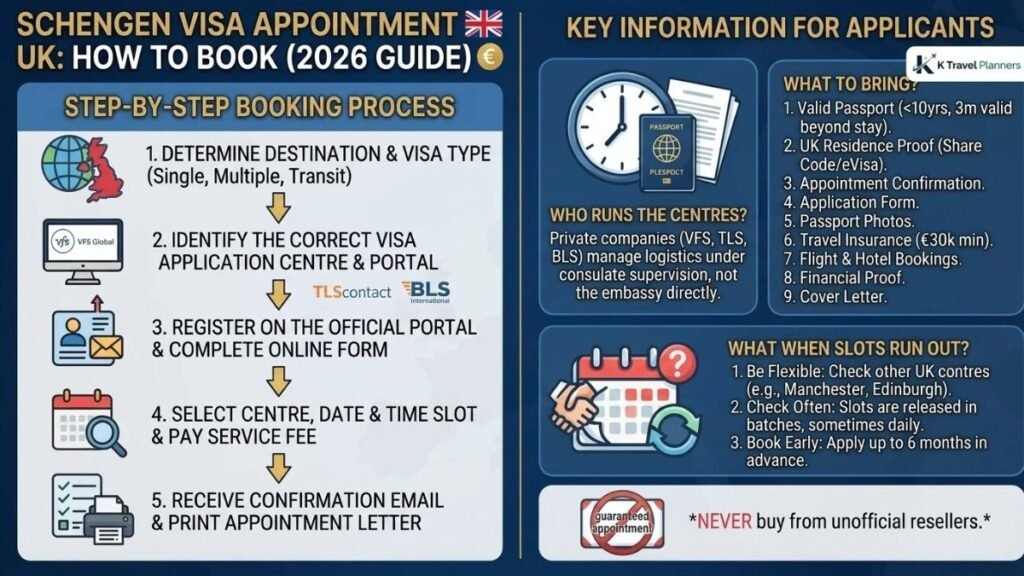
To book a Schengen visa appointment in the UK, you go to the booking page of the visa application centre (or embassy) that handles your destination country, choose your visa category and centre, pick an available date, and confirm. Most applicants then attend in person to submit documents and give fingerprints. The provider depends on the country: for example, TLScontact handles France and Germany, VFS Global handles Italy, and BLS handles Spain, but always confirm on the embassy’s own page.
If you’re about to apply for a Schengen visa from the UK, the appointment is often the part that causes the most stress. Not the paperwork, not the fee, but simply getting a date. Slots can be scarce, the booking systems differ from country to country, and there’s no shortage of websites ready to sell you something you can usually get for free.
This guide explains how the system works, who actually runs it, how to book step by step, what to bring, and what to do when the calendar looks empty.
K Travel Planners is an independent consultancy. We are not an embassy, consulate or official visa centre, and we can’t make or influence visa decisions or appointment availability.
Who decides, and who just takes your documents?
It helps to separate two roles.
The embassy or consulate of your destination country decides your visa. Nobody else can.
The visa application centre is a commercial company, appointed by that country, which accepts your application, checks it’s complete, collects your fingerprints and photo, and sends the file on. It doesn’t make the decision and it can’t tell you what the decision will be.
Some countries also accept applications directly at their embassy or consulate for certain cases. Most UK applicants, though, will go through one of three providers: TLScontact, VFS Global or BLS International.
Which provider handles which country?
This changes from time to time, so treat the table as a starting point and confirm on the embassy’s own website before you book.
| Destination | Usually handled by | Which centre can you use? |
|---|---|---|
| France | TLScontact (London, Manchester, Edinburgh) | Generally any UK centre; complete the France-Visas online form first |
| Germany | TLScontact | Assigned by where you live; the embassy publishes a district map |
| Belgium | TLScontact | Confirm on the embassy page |
| Italy | VFS Global | Assigned by where you live |
| Spain | BLS International | Assigned by where you live (Edinburgh for Scotland, Northern Ireland and parts of northern England) |
| Netherlands | VFS Global | Check the Netherlands embassy page |
| Portugal | VFS Global | Assigned by where you live |
| Switzerland | VFS Global | Check the embassy page |
Status as of late 2026, based on embassy pages and published directories. Verify each row before you book.
Notice the last column. Some countries let you choose any centre in the UK. Others assign you to a centre by postcode, which means you can’t simply pick the one with the shortest queue. If you want more detail for a particular destination, our country pages cover Italy, France, Spain, Germany, the Netherlands, Portugal, Belgium and Switzerland.
Before you book: get the order right
People often rush to grab a slot and then discover they aren’t ready. A better order looks like this.
1. Be sure you need a visa and which type. If you’re unsure, start with whether you need a Schengen visa if you live in the UK and the differences between Schengen visa types.
2. Choose the right country. Apply to your main destination, or the country of first entry if there isn’t one. Our guide on which Schengen country to apply to explains the logic. Don’t book a country because it has slots. A mismatch with your itinerary is a problem you can avoid.
3. Check the earliest date you can apply. You can apply up to six months before your trip. Booking too early for your travel dates can be refused or cancelled by the system.
4. Read the destination’s own instructions. Some countries need an online form completed before you can book. France, for example, uses an online application through France-Visas.
5. Start gathering documents now. Don’t wait for the date. Our documents checklist shows what to prepare, and the cover letter tips help you explain the purpose of your trip.
How to book, step by step
- Go to the official booking page. Reach it from the embassy or consulate’s own website, not from a search ad or a social media link.
- Create an account with the provider, using your name exactly as it appears in your passport.
- Choose the visa category and purpose. Tourism, business and family visits are usually separate options.
- Select your centre if the country allows a choice.
- Pick a date and time from the available slots.
- Confirm and save everything. Keep the confirmation email and any reference number, and print the appointment letter if one is provided.
- Check the dates against your travel plan. If your trip is close, factor in decision time and passport return.
Booking an appointment is generally free of charge. What you pay at the centre is the visa fee and any service fee, and optional extras are optional. If a website is asking for money simply to show you a calendar, treat it with caution.
What to bring to the appointment
Appointment letters and checklists differ, but expect to bring:
- Your passport and a copy of the photo page
- The appointment confirmation
- The completed, signed application form
- Photographs that meet the Schengen standard
- Your supporting documents, in the order the checklist asks for
- Proof of UK residence, such as your eVisa share code details, if the country requires it
- Payment method for the visa and service fees (check which methods the centre accepts)
At the counter, a staff member checks your file is complete and takes your fingerprints and a digital photo. If you’ve given fingerprints for a previous Schengen visa recently, they can often be reused, but that depends on the consulate, so don’t assume.
Walk-in appointments exist at some centres for limited cases, such as certain business or conference travel, but they aren’t a reliable plan. Always check the embassy’s page first.
What if there are no appointments?
This is the problem most people search for, so let’s be practical about it.
Check at different times. Slots are released and cancelled throughout the week. Looking once and giving up often misses them.
Check other centres, if your country allows it. For destinations with a free choice of centre, London, Manchester and Edinburgh may have very different availability. If your country assigns you by postcode, you generally can’t switch.
Look at your dates. If you can move your trip by a week or two, availability can change a lot. Book flights and hotels you can change or cancel before the visa is decided.
Read the embassy’s page for urgent cases. Some consulates have a process for genuine emergencies, such as medical or bereavement travel. It’s narrow and they’ll ask for proof.
Be careful with paid “slot finders”. Automated tools and resellers advertise appointment slots for a fee, and there’s growing reporting on bots grabbing free slots to resell them. Some break the provider’s terms of use, and some are simply scams. A legitimate booking never needs a stranger’s payment. Our guide to avoiding scams is a starting point, and if you want help understanding the official process, you can look at our Schengen visa appointment assistance.
Don’t switch countries just to get a slot. It might get you a date, but it makes your application inconsistent with your real itinerary.
Timing and calendar traps
A few things quietly eat into your schedule.
Holidays. Embassies and centres close on UK public holidays and on their own national holidays. December is especially tight, because several missions publish extra closures. Check the specific dates for your embassy.
Decision time. The usual decision period is 15 calendar days, but it can be longer. That’s separate from the wait for an appointment.
Passport return. You’ll be without your passport while it’s being processed. If you need it for other travel, plan around that.
Premium services. Centres may sell premium lounges or similar extras. These generally don’t mean an earlier appointment or a faster decision, so read the provider’s own wording before paying.
Here’s an illustrative example. Marcus, a Nigerian passport holder with a Skilled Worker visa in Leeds, wants to attend a conference in Madrid in March. He starts looking in mid-February and finds nothing for three weeks. His plan only works because he’d already gathered his documents and could take the first cancellation slot that appeared. The ones who struggle are often the people who start the paperwork only after they find a date.
Common mistakes with appointments
Booking on a look-alike website. Always begin from the embassy’s page.
Booking the wrong category. A tourism appointment for a business trip can cause delays.
Turning up without the printed form or confirmation. Check the checklist the night before.
Ignoring jurisdiction rules. If your country assigns you by postcode, booking at the wrong centre can mean being turned away.
Not allowing for rescheduling rules. Providers have their own rules on changing or cancelling slots. Read them when you book.
How K Travel Planners can help
We can’t guarantee an appointment, a processing time or a visa, and nobody honest can. What we can do is help you understand the official booking steps, prepare your documents against the right checklist, and make sure your application tells one consistent story. See our Schengen visa appointment assistance or Schengen visa consultation, or get in touch with your passport nationality, destination and rough travel dates. Please don’t send passport scans or financial documents until a secure method has been agreed.
For the bigger picture, our complete guide to applying for a Schengen visa from the UK walks through every stage.
Frequently asked questions
How do I book a Schengen visa appointment in the UK?
Go to the booking page of the provider that handles your destination country, which you can find on the embassy or consulate’s own website. Create an account, choose your visa category and centre, pick a date, and save the confirmation. The provider depends on the country, for example TLScontact for France and Germany, VFS Global for Italy, and BLS for Spain.
How far in advance should I book?
You can apply up to six months before your trip. Book as early as your travel dates allow, and start preparing documents before you have a slot, because the wait for an appointment varies a lot between countries and seasons.
Can I choose any visa centre in the UK?
It depends on the country. Some, such as France, generally allow any UK centre. Others, such as Germany, Italy, Spain and Portugal, assign you by where you live. Check the embassy’s page for the rule that applies to you.
Do I need an appointment, or can I walk in?
Most applicants need an appointment. Some centres accept walk-ins for limited categories, such as certain business or conference travel, but you shouldn’t rely on it. Check the embassy’s page before you travel to a centre.
Is it free to book an appointment?
Booking is generally free. You pay the visa fee and any service fee at the application stage. Be cautious about any site that charges simply to show you available dates.
Do premium services get me an earlier appointment?
Usually not. Providers state that premium lounges or similar services don’t guarantee earlier slots or faster processing. Read the provider’s own terms before paying.