
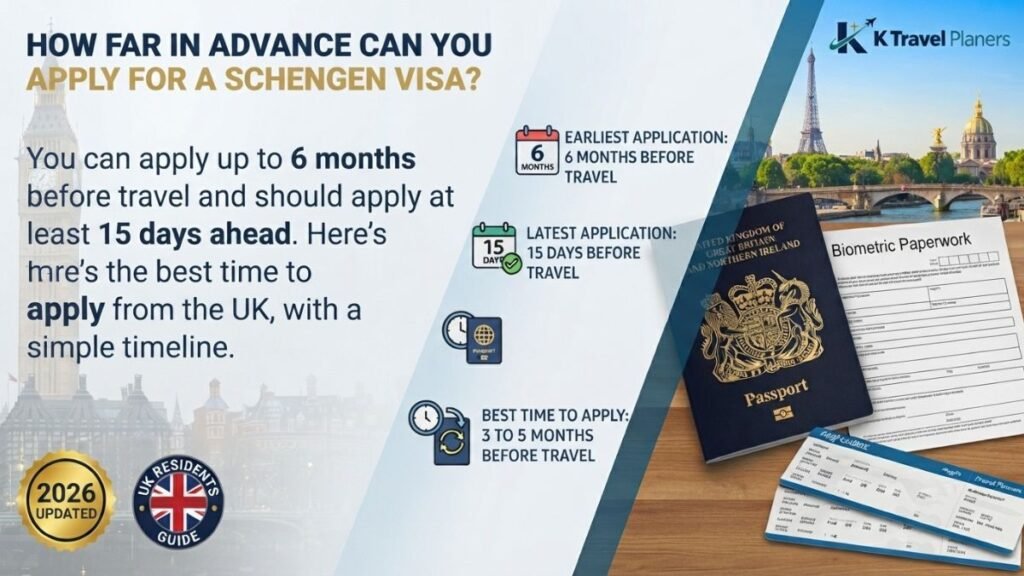
You can apply for a Schengen visa up to six months before the start of your trip (nine months for seafarers on duty), and, as a rule, no later than 15 calendar days before it. Applications lodged outside that window can be refused as inadmissible. For most UK-based applicants, a realistic plan is to start preparing two to three months ahead and book the appointment as soon as your travel dates allow.
“Six months” and “15 days” get quoted everywhere, and they’re correct. But they’re the legal edges of the window, not a plan. Apply at the very start and you may hit a date you can’t commit to. Apply near the end and you’re relying on everything going perfectly: an appointment slot, complete documents, a quick decision and a prompt passport return.
This guide explains the rules, why they’re more nuanced than they look, and how to work out the right time for your own trip.
K Travel Planners is an independent consultancy. We are not an embassy, consulate or official visa centre, and we can’t make or influence visa decisions or appointment availability.
The rules in plain language
The timing comes from Article 9 of the EU Visa Code, and your destination embassy’s website will repeat it.
| Rule | What it says |
|---|---|
| Earliest you can apply | No more than six months before the start of your intended visit. Nine months for seafarers in the performance of their duties |
| Latest you should apply | As a rule, no later than 15 calendar days before the start of your visit |
| Late applications | In justified, individual cases of urgency, a consulate may accept an application later than 15 days. It’s discretionary, not a right |
| Appointments | Where an appointment is required, it should as a rule take place within two weeks of the request. In practice, availability varies a lot |
| Decision time | Normally 15 calendar days from when your application is accepted. Can extend to 45 days in individual cases, for example when further checks are needed |
Two details are worth underlining.
The six months are counted back from the start of your trip, not forward from today. If you’re travelling on 20 September, the earliest date you can apply is 20 March.
The 15 days are counted from when you travel, not from when you book the appointment. An appointment on day 16 before travel leaves you almost no margin if the consulate needs more time.
What happens if you apply too early?
If you lodge an application more than six months before your travel date, the consulate can treat it as inadmissible. In plain terms, they may decline to examine it and may not accept it at all. The details of what happens to your fee depend on the country and the circumstances, so don’t assume you’ll get it back.
The practical advice is simple: don’t try to apply early “just in case”. Wait until your travel date is within six months, then book.
What happens if you apply too late?
The decision time is normally 15 days, but it can be 45 or more in individual cases. If your trip starts in three weeks and your application needs further scrutiny, a decision may arrive after your flight leaves.
Late applications aren’t automatically refused, but they’re a risk you’re carrying yourself. An urgent-case exception exists for genuinely urgent situations, such as a medical emergency, and the consulate decides. It isn’t a way to extend your planning window.
Why “as early as possible” isn’t always the answer
It sounds like the safest rule is to apply on the first day you can. That’s often sensible, but not always.
Your visa is tied to your dates. The validity of the visa follows the dates in your application. Applying early doesn’t give you extra days or flexibility. If your plans move, the visa doesn’t move with them.
Your documents need to be current on the day you apply. Bank statements, employer letters and insurance dates should reflect your situation when you submit. Our documents checklist shows what typically needs to be recent.
Your UK status needs to cover the trip. If your UK permission expires soon, consulates may want to see that it extends comfortably beyond your return. Check your embassy’s checklist, and plan around any renewal.
Bookings are easier to keep flexible than to rebook. If you apply early and your dates change, you may need to start again.
The sweet spot for most people is to apply when your plans are firm, your documents are ready and you can still allow generous margins, which is usually somewhere between three months and six weeks before travel.
A practical timeline from the UK
This planner works backwards from your departure date. Treat the weeks as a guide, not a rule, because appointment availability varies by country and season.
| When (before travel) | What to do |
|---|---|
| 6 months | Earliest legal date to apply. Check your embassy’s rules and booking system |
| 3 to 4 months | Confirm you need a visa (see do you need a Schengen visa), choose your main destination and start planning your itinerary |
| 3 months | Start gathering documents: bank statements, employer or university letters, insurance, flexible bookings |
| 2.5 to 3 months | Book your appointment as soon as the booking system allows for your dates |
| 2 months | Finalise the cover letter, itinerary and form. Cross-check dates and names |
| 6 to 8 weeks | Attend your appointment if you can get one. This leaves room for a longer decision |
| 4 weeks | Decision window. Track the application through the official route |
| 2 weeks | Last comfortable point to have a decision. Check your passport has been returned |
| 15 days | The “as a rule” cut-off. Applications from here carry real risk |
If your trip falls in a busy season, such as the summer holidays, Easter or Christmas, add extra margin. Appointment slots fill faster and some missions and centres have holiday closures.
How appointments fit into the timeline
The legal window says nothing about when you’ll actually get a slot. A few things shape that.
Booking windows vary. Some centres release slots on a rolling basis, and some missions open them on a fixed schedule, for example a few times a month. Always check the specific embassy page.
Appointments are separate from the six-month rule. You can only lodge the application within the six-month window, so booking too early for your travel dates may not be possible.
Delays happen. The Visa Code says an appointment should, as a rule, be available within two weeks of the request, but real-world availability varies. Our appointment guide explains how booking works and what to do when slots are scarce.
Your fingerprints may help next time. If your fingerprints were entered into the visa system less than 59 months ago, they can often be reused for a new application, which can simplify things for repeat applicants. It depends on the consulate, so don’t assume.
An example to make it concrete
Here’s an illustrative scenario, not a real client case.
Naveed lives in Glasgow, holds a Pakistani passport and a UK work visa, and plans a conference trip to Munich on 14 September. The earliest he can apply is 14 March. He doesn’t want to wait until the last minute, but he also doesn’t know his exact conference dates until June.
He confirms the dates in late June, books a changeable flight and hotel, and starts his documents the same week. He books an appointment for early July and attends it six weeks before travel. The decision comes through in about two and a half weeks, with the rest of the time acting as a buffer.
If he’d applied in March using guessed dates, his visa would have been tied to dates he didn’t need. If he’d waited until mid-August, he’d have been relying on everything going right. The middle route gave him room for a slow week or a document he’d forgotten.
Common timing mistakes
Applying with uncertain dates. If the dates aren’t firm, don’t apply yet. Fix them first.
Counting the six months from today. It’s six months before the trip, not six months from now.
Booking non-refundable travel before the decision. Choose refundable flights and hotels. Our itinerary guide explains how to plan this.
Forgetting the appointment wait. The 15 days is a minimum for lodging, not for the whole process.
Ignoring holiday closures. Embassies and centres close on UK and national holidays.
Leaving the passport tied up. You won’t have your passport during processing, so plan any other travel around it.
Applying to a country because it has slots. If appointments are scarce, adjust the dates or look at other legitimate options. Don’t switch to a country that isn’t your real main destination. Our guide on which Schengen country to apply to explains why.
If you’re running short of time
Sometimes the trip comes up quickly. If your travel date is closer than you’d like:
- Check the embassy’s page for any urgent or priority route, which is usually limited to genuine emergencies.
- Check availability regularly, since cancellations appear throughout the week.
- Have your documents ready so you can take a slot the moment it appears.
- Be cautious of anyone who promises a guaranteed fast appointment. Nobody can, and scams are common.
- Consider moving the trip, if it’s flexible. A short delay is often better than a rushed, thin application.
If you’ve had a refusal, don’t panic about timing. Our guide on Schengen visa refusals explains what to do next, including how appeal deadlines work.
How K Travel Planners can help
We can’t guarantee a visa, an appointment or a processing time, and nobody honest can. What we can do is help you build a realistic timeline, organise your documents against the right checklist, and understand the official booking process. See our Schengen visa appointment assistance or Schengen visa consultation, or get in touch with your passport nationality, UK status, destination and travel dates. Please don’t send passport scans or financial documents until a secure method has been agreed.
For the whole process in one place, see our complete guide to applying for a Schengen visa from the UK. For the latest on fees, EES and ETIAS, read our 2026 changes guide, and if you’re unsure which type you need, see Schengen visa types explained.
Frequently asked questions
How early can I apply for a Schengen visa?
Up to six months before the start of your trip, or nine months for seafarers in the performance of their duties. Applications lodged earlier than that can be treated as inadmissible.
What’s the latest I can apply?
As a rule, no later than 15 calendar days before your trip starts. A consulate may accept a later application in a justified, urgent case, but that’s at its discretion, and a decision may not arrive in time.
Is two weeks enough for a Schengen visa?
It’s possible but risky. The normal decision time is 15 calendar days, which can extend to 45 in individual cases. You’d also need an appointment quickly. A buffer of several weeks is much safer.
Can I apply a year in advance?
No. The earliest you can lodge an application is six months before your travel dates. You can start planning and gathering documents earlier, but you can’t submit before that window opens.
Does applying early make approval more likely?
Not by itself. Early applications give you more time to fix problems, but the decision depends on your evidence and the consulate’s assessment. A well-prepared application submitted with a sensible margin is the aim.
What if my trip dates change after I apply?
Small changes can be manageable, but your visa is tied to the dates in your application. If your dates change significantly, check with the embassy before you travel, and avoid non-refundable bookings until you hold the visa.