
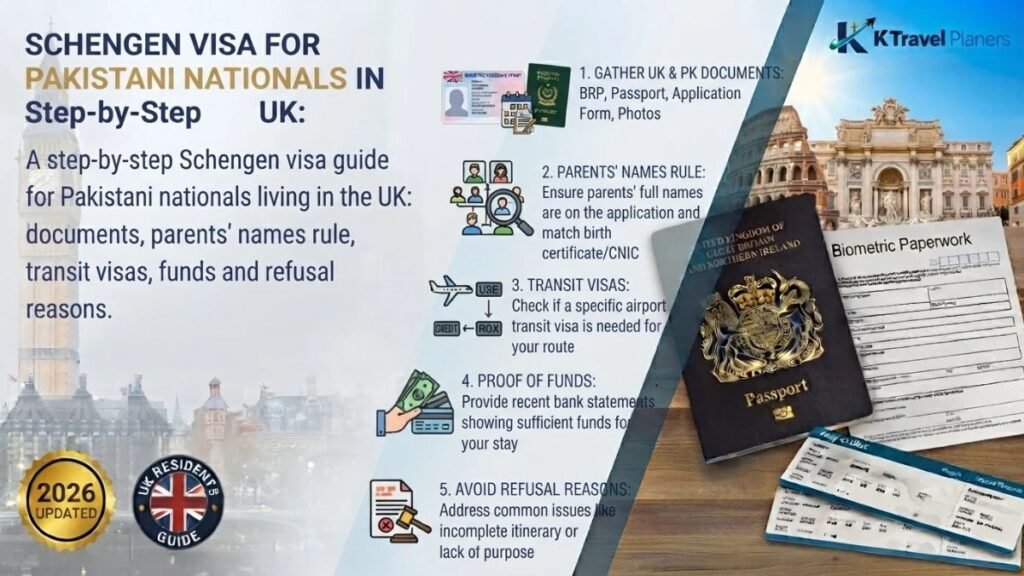
Yes. If you hold a Pakistani passport and live lawfully in the UK, you can apply for a Schengen visa from the UK, through the embassy or visa centre of your main destination. You’ll need a visa for any short stay, whatever your UK status, including ILR. You may also need an airport transit visa for some connections. The process is the same as for everyone, but some consulates ask for extra evidence, such as your parents’ names, and they look closely at your purpose, funds and ties to the UK.
Plenty of Pakistani nationals in the UK have built their lives here for years. They have jobs, homes, children in school, a settled status. And yet when they plan a holiday in Rome or a family visit in Germany, they’re told they need a visa, and the process feels harder than it should.
It’s fair to feel frustrated by that. It’s also useful to know the rules, because most of the difficulty comes from a few predictable things: unclear paperwork, mismatched dates, and missing Pakistan-specific documents. All of them are fixable if you plan ahead.
This guide takes you through the process step by step, with the details that matter for Pakistani passport holders applying from the UK.
K Travel Planners is an independent consultancy. We are not an embassy, consulate or visa application centre, and we can’t make or influence visa decisions. Rules and checklists change, so confirm everything on your destination embassy’s own pages.
First, the honest picture
You may have seen high refusal figures for Pakistani applicants. They’re real, but they need context.
Published European Commission statistics for 2025 show that applications lodged in Pakistan were refused at around 46%, compared with an overall Schengen refusal rate of around 14.5%. Reports in late 2026 say an EU commissioner described a refusal rate near 50% as too high and said the quality of documents submitted needed to improve.
Two cautions. First, those figures are for applications made in Pakistan, not from the UK, and applicants in the UK often present a different profile. Second, a rate tells you nothing about your own application. Refusals usually come from specific weaknesses in a file, such as an unclear purpose, funds that don’t fit the trip, or doubts about returning.
So the useful reading is this: consulates look carefully, and a clear, consistent, well-evidenced application matters a great deal.
Do you need a visa, and what about transit?
Short stays. A Pakistani passport is on the EU’s list of nationalities that need a visa for short stays. Living in the UK, even with ILR, doesn’t change that. Our guide on whether you need a Schengen visa if you live in the UK explains why your passport decides, not your address.
Airport transit. Pakistan is on the EU’s common list of nationalities that need an airport transit visa (Type A) for connections through Schengen airports, though individual countries can add their own rules or exemptions. Italy’s consulate, for example, says UK residents holding a valid UK BRP don’t need an airport transit visa for Italian airports. Check the airport country’s rule before you book any flight with a Schengen connection. See our guide on Schengen visa types.
If you also hold a British passport. Then you travel on your British passport and don’t need a Schengen visa for short stays. Use the same passport consistently throughout the trip.
The step-by-step process
Step 1: Check your UK status and its validity
Consulates generally want to see that your UK permission is valid comfortably beyond your return date. Italy’s checklist, for instance, mentions at least one month in one place and three months in another, so aim for three. If your UK permission is close to expiring, deal with that first. You’ll usually evidence status with a share code from your eVisa, and some consulates want a printed copy.
Step 2: Check your passport
Common requirements are validity of at least three months after your planned departure, at least two blank pages, and issue within the last ten years. Renewing a Pakistani passport from the UK can take time, so do it early if you’re close to the limit.
Step 3: Choose your main destination
You apply to the country where you’ll spend the most nights, or the country of first entry if your time is evenly split. Don’t pick a country because it seems easier. Our guide on which Schengen country to apply to explains why this matters, and our itinerary guide shows how to plan the trip so it’s clear.
Step 4: Gather the Pakistan-specific documents
This is the step that surprises people most.
Parents’ names. The Italian consulate in London says citizens of Pakistan, Afghanistan, Iraq, Palestine and Yemen must provide their mother’s and father’s full names, evidenced by a birth certificate or a consular declaration. If you’re applying to Italy and don’t have your birth certificate to hand, start early.
Certificates issued outside the UK. For Italy, birth, marriage or family certificates issued abroad must be translated into English or Italian and legalised, either by the Italian consular office in the country that issued them or by that country’s consular authority in the UK. Other consulates have their own rules, so check the embassy checklist.
Names that match. Your name should appear the same way on your passport, bank, employer letter, share code and application form. Differences in spelling, order or how a father’s or husband’s name is used can cause confusion, so fix any mismatch before you apply.
Relationship evidence. If you’re visiting family, you may need an invitation letter, your host’s ID or residence permit, and proof of the relationship.
Step 5: Build your UK evidence
This is how you show your life is based in the UK. Typically that means:
- Employed: an employer letter with the details your embassy asks for, recent payslips, and evidence of approved leave
- Self-employed: accountant’s letter, tax records and business evidence
- Student: enrolment letter, term dates and proof you’ll return to your course
- Retired or unemployed: pension or benefit letters and sponsor documents where relevant
- Home and family: tenancy or mortgage evidence, children’s school letters, where relevant
Our documents checklist lists the general categories, and our Italy checklist shows how a consulate sets out the details, including an employer letter that must be under a month old.
Step 6: Show funds that fit the trip
Most consulates ask for around three months of personal UK bank statements showing regular income and a balance that comfortably covers your trip. Don’t make last-minute deposits, and if there’s an unusual transaction, explain it honestly with evidence. If someone else is paying, you’ll usually need their documents and a sponsor letter.
Step 7: Write a clear cover letter and itinerary
Where your embassy asks for a cover letter, keep it to one page, factual, and consistent with your itinerary. Our cover letter tips explain the tone. Make sure the dates, hotels and bookings match everywhere.
Step 8: Book your appointment
Find your destination’s provider and check whether you can choose any centre or have to use the one for your district. Our guide to UK visa centres lists the providers, and our Italy appointment guide shows a worked example. For timing, see how far in advance to apply and our general appointment booking guide.
Step 9: Attend and submit
Bring everything printed, in the order the checklist asks for. Give your fingerprints and photo, and keep your receipt and tracking details. The consulate decides, and processing can take up to 45 days in some cases.
Step 10: Check the visa when it arrives
Look at the name, dates, number of entries and duration of stay. If something’s wrong, raise it straight away. Remember that a visa lets you present yourself at the border but doesn’t guarantee entry. The Entry/Exit System now records crossings, as explained in our 2026 changes guide.
What consulates tend to focus on
Consulates assess each application individually, including the risk that an applicant might not leave when the visa ends. For Pakistani applicants, the practical questions in an officer’s mind are usually:
| Question | What helps |
|---|---|
| Is the purpose clear and believable? | A consistent itinerary, bookings, cover letter and invitation where relevant |
| Is there enough money, and is it genuine? | Regular income in statements, a balance that fits the trip, explained deposits |
| Are there real ties to the UK? | Employment, study, home, family, a long UK residence |
| Are the documents reliable? | Matching names, dates and amounts across every document |
| Have you travelled and returned before? | Previous visas used lawfully, which can also help with multiple-entry visas |
On that last point, multiple-entry visas follow a general ladder based on lawful previous visa use. The India-specific rule people sometimes cite doesn’t apply to Pakistani applicants. Our guide on how nationality affects a Schengen application from the UK explains it.
Does ILR help?
It helps in one specific way: it’s strong evidence of settled, lawful residence in the UK, and it supports the idea that your life is here. It doesn’t remove the visa requirement, and it doesn’t replace evidence of your job, funds and purpose. Treat it as part of the picture, not the whole picture.
An example to make it concrete
Here’s an illustrative scenario, not a real client case.
Bilal is a Pakistani student at a university in Coventry. He wants to visit a friend in Rome for a week during the Easter break. He holds a UK student visa valid for another eighteen months.
He starts early. He asks his university for a letter confirming his enrolment and term dates, and the bank statements show his savings and a regular family transfer. He realises that Italy asks for his parents’ full names to be evidenced, so he finds his birth certificate and has it ready. He notices his bank lists his name as “Muhammad Bilal Ahmed” while his passport shows “Bilal Ahmed”. He asks the bank to correct it.
None of that is dramatic. Each is a small mismatch that could have caused a question on the day. Because he fixed them early, his file tells one clear story.
Common mistakes
Assuming ILR removes the visa requirement. It doesn’t.
Missing the parents’ names rule for Italy. Start the birth certificate early.
Skipping translation or legalisation. Check each embassy’s rules for documents issued in Pakistan.
Name mismatches. Fix spelling and order differences across all documents.
Missing the transit rule. Check the connecting airport country’s requirements before booking.
Applying to the “easiest” country. Apply to your real main destination.
Last-minute deposits and unexplained funds. They can look worse than modest honest savings.
An employer letter that’s too old. Many consulates, like Italy’s, want it under a month old.
Using social media “agents” or lookalike booking sites. Always book from the embassy’s own link.
Treating a past refusal as the end. Our guide on Schengen visa refusals explains what to do next.
Quick checklist
- [ ] Confirmed you need a visa (and checked transit rules)
- [ ] UK status valid comfortably beyond your return, share code printed
- [ ] Passport valid 3+ months after departure, 2 blank pages, issued within 10 years
- [ ] Main destination chosen from your itinerary
- [ ] Birth certificate or parents’ names evidence if your embassy asks
- [ ] Documents issued in Pakistan translated and legalised if required
- [ ] Names match across passport, bank, employer and form
- [ ] Employer, university or accountant letter current
- [ ] Three months of statements with income visible
- [ ] Cover letter and itinerary consistent
- [ ] Appointment booked from the embassy’s link
How K Travel Planners can help
We can’t guarantee a visa, an appointment or a processing time, and nobody honest can. What we can do is help you work out which rules apply to your passport and UK status, check your documents against the right checklist, and make sure your file tells one consistent story. See our personalised Schengen support or Schengen visa consultation, or get in touch with your UK status, destination and travel dates. Please don’t send passport scans or financial documents until a secure method has been agreed.
For the whole process, see our complete guide to applying for a Schengen visa from the UK, and our Italy country page for country detail.
Frequently asked questions
Can Pakistani nationals living in the UK apply for a Schengen visa from the UK?
Yes, if you’re lawfully resident in the UK. You apply through the embassy, consulate or authorised visa centre of your main destination. Some consulates assign applicants to a centre by where they live, so check your destination’s rules.
Do Pakistani passport holders with ILR need a Schengen visa?
Yes, for short stays. ILR shows settled UK status but doesn’t change which list your passport is on. It does help show your ties to the UK.
Do Pakistanis need an airport transit visa?
Pakistan is on the EU’s common list for airport transit visas, though some countries add their own rules or exemptions. Italy, for example, says UK residents with a valid BRP don’t need one for Italian airports. Check the connecting airport country’s rule before you book.
Does Italy ask for my parents’ names?
Yes. The Italian consulate in London says citizens of Pakistan, among others, must provide their mother’s and father’s full names, evidenced by a birth certificate or a consular declaration.
Why are so many Schengen applications from Pakistan refused?
Published EU figures show high refusal rates for applications lodged in Pakistan, but refusals depend on specific weaknesses, such as unclear purpose, funds that don’t fit the trip, doubts about returning, or inconsistent documents. A clear, consistent file helps.
Can I get a multiple-entry Schengen visa from the UK?
Possibly, depending on your travel record and the consulate’s assessment. The general ladder rewards lawful use of earlier visas with 1-year, 2-year and eventually 5-year multiple-entry visas. A first application usually covers your trip dates.